Cribbage History
Cribbage Club Free
The best way to learn Cribbage is to practice with a patient teacher. Play Cribbage anywhere on your Android phone or tablet with this free game.


Origins
Credit for creating the game of Cribbage is given to Sir John Suckling, an early 17th Century English Cavalier poet. Suckling was quite a character, known as a soldier, a gambler, an aristocrat, and a notorious ladies man.
Suckling derived the game of Cribbage from an even earlier game known as "Noddy". While Noddy has pretty much disappeared, Cribbage is alive and well and enjoyed by many to this day. His poetry, not so much...
I am a man of war and might,
And know thus much, that I can fight,
Whether I am i'th' wrong or right, devoutly.
No woman under heaven I fear,
New Oaths I can exactly swear,
And forty Healths my brain will bear most stoutly.
I cannot speak, but I can doe
As much as any of our crew;
And if you doubt it, some of you may prove me.
I dare be bold thus much to say,
If that my bullets do but play,
You would be hurt so night and day, Yet love me.
– Sir John Suckling, "A Soldier"
Guardian of the Cribbage Board
During World War II, card games were a common form of entertainment for US sailors. Cribbage was particularly popular with submariners, and the USS Wahoo, a Gato class submarine launched into the Pacific theater in 1942 was no exception.
Aboard the Wahoo, were Executive Office Richard H. O’Kane, and his commanding officer, Dudley “Mush” Morton.
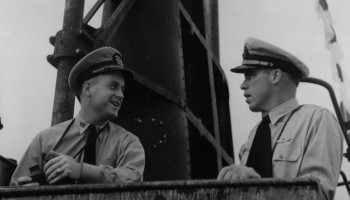
O’Kane speaks with his commanding officer, Dudley Morton, on the bridge of the Wahoo c. February 1943
Now the Cribbage games between O’Kane and Morton were something of a legend among the crew, a welcome stress relief and a way to pass the time during patrols. According to the naval lore, while patrolling the shallow waters of the Yellow Sea during its fourth war patrol, Morton dealt O’Kane a perfect 29, the highest possible score for a Cribbage hand. The crew felt it was a lucky omen, and later than night, the Wahoo sank two Japanese freighters.
A tradition was started, and O’Kane’s Cribbage board has been passed from the oldest submarine to the next ever since.